The IRS doesn’t get forever to collect what you owe. Once a tax is assessed, the agency generally has a fixed window to collect it, and after that window closes, the debt is supposed to fall off the books. Most people never hear that number from the IRS directly; they find out by accident, or not at all.
This tool gives you a working estimate of that deadline in under a minute. Enter your assessment date, flag anything that may have paused the clock, and you’ll see roughly where your account stands.
It’s built around the same 10-year rule the IRS applies to nearly every account. Treat the result as a starting point, not a final answer, since suspensions and multiple assessments can shift the real date.
How This Calculator Works
The tool runs on three inputs, and each one changes your estimate directly:
- Assessment date. This is the date on your IRS account transcript, not your filing date or the date you stopped paying. It’s the single most important number in the whole calculation.
- Statute-changing events. A short list of situations: bankruptcy, an Offer in Compromise, an installment agreement dispute, a Collection Due Process hearing, and a few others that the IRS treats as reasons to pause or extend the clock.
- A verified adjustment, if you have one. If you already know how many days were added to your account, you can enter that number. If not, leave it blank rather than guess.
Once you hit calculate, you’ll get a result date, the standard collection period applied, and roughly how much time is left on the clock. If you selected any statute-changing events without entering a specific adjustment, the tool relabels that date as your earliest possible CSED rather than a final one, since every qualifying event only pushes the real deadline later.
For the fuller picture of how this deadline fits alongside liens, levies, and other IRS actions, see our IRS collection timeline breakdown.
This is deliberately a simplified version of the IRS collection statute of limitations. The full picture involves rules the IRS applies case by case, and no calculator should pretend to replicate all of them from a handful of checkboxes.
How the IRS Calculates Your Collection Deadline
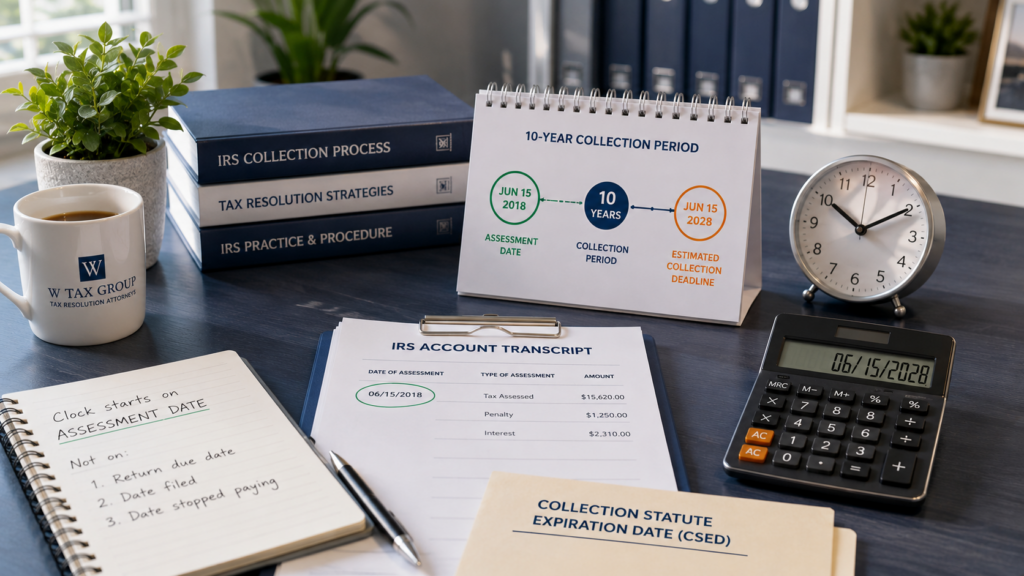
The math behind the standard estimate is straightforward on paper:
Assessment Date + 10 Years = Estimated Collection Deadline
If a tax was assessed on June 15, 2018, the standard deadline lands around June 15, 2028. No more, no less, assuming nothing along the way paused the clock.
The part that trips people up is the starting point. The clock doesn’t start on:
- The date your tax return was due
- The date you actually filed
- The date you stopped paying
It starts on the date the IRS formally recorded the liability on its books, known as the assessment date. That date shows up on your account transcript, and for many taxpayers it’s later than they’d expect, especially after an audit, an amended return, or a return the IRS filed on your behalf.
If the IRS ever filed for you, our page on Substitute for Return assessments walks through how that date gets set and why it often differs from when you originally should have filed.
The Collection Statute Expiration Date, often shortened to CSED, is simply the day that 10-year window closes. Our breakdown of the 10-year statute covers the rule itself in more depth if you want the full mechanics behind it.
Worth noting: this is different from the IRS’s audit and assessment deadlines, which usually run just three years from filing.
If you’re trying to figure out how long the IRS has to audit a return rather than collect an existing debt, that’s a separate clock covered on our IRS audit statute of limitations page.
What Can Pause or Extend the Clock
A handful of situations stop the clock from running, then pick back up once they resolve. The calculator asks about these because leaving them out would make the standard math misleading:
- Bankruptcy. Collection is generally suspended while a bankruptcy case is open, plus an additional period after it closes.
- An Offer in Compromise. The clock pauses while your Offer in Compromise is under IRS review, and again if you appeal a rejection.
- An installment agreement request or appeal. Time spent waiting on a decision about a payment plan, or appealing one that was denied, can pause collection.
- A Collection Due Process hearing. Requesting a CDP hearing after certain IRS notices, including through the Collection Appeals Program, suspends the clock while it’s pending.
- Innocent spouse relief. Filing for innocent spouse relief pauses collection on the portion of the debt in question.
- Living outside the U.S. Time spent abroad for six or more continuous months can suspend the statute for that period.
- Certain military service. Combat zone service and some other military circumstances extend the deadline as well.
- A Taxpayer Advocate assistance order (TAO). Requesting help from the Taxpayer Advocate Service can pause the clock while your case is under review.
- A signed Form 900 waiver. In some installment agreement situations, the IRS asks taxpayers to sign a waiver extending the collection period beyond the standard 10 years.
- A court judgment. If the IRS sues and reduces a tax debt to a judgment, the 10-year cap no longer applies, and collection can continue until the judgment is satisfied.
None of these pause the clock by a fixed, universal number of days. A bankruptcy that lasts four months doesn’t add four months flat; the actual math depends on dates the IRS tracks internally.
That’s why the calculator shows the earliest possible date rather than guessing at a final one, and why it’s worth confirming any of these against your own transcript before relying on it.
When the Deadline Passes, and Why One Account Can Have Several
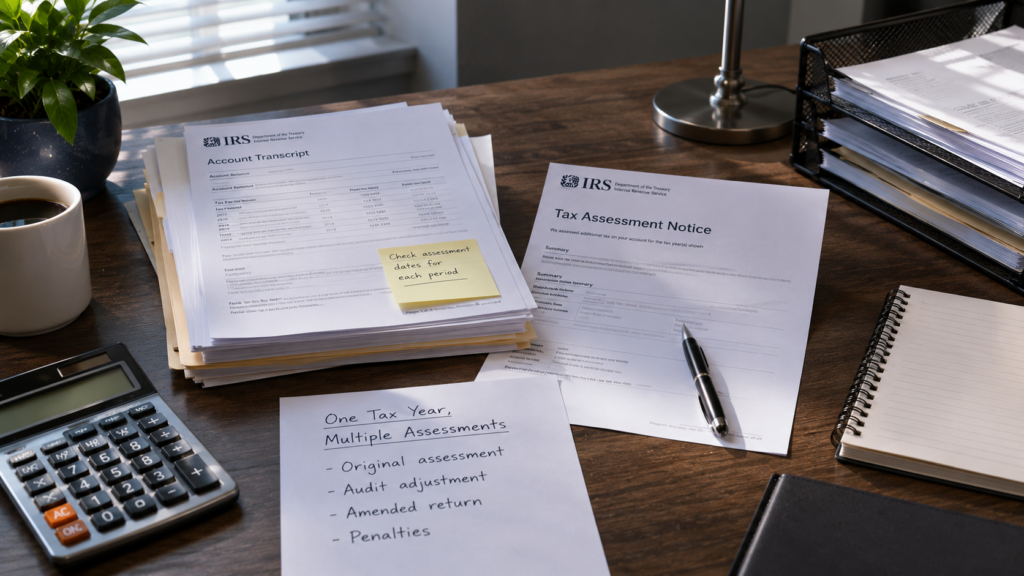
When a CSED is reached without being extended, the IRS is generally supposed to stop pursuing that specific liability and remove it from active collection. In practice, that only applies cleanly when there’s a single, uncomplicated assessment behind it.
Most tax debts aren’t that simple. A single tax year can carry more than one assessment, each running on its own separate clock:
- The original assessment from your filed or IRS-filed return
- A later assessment from an audit adjustment
- An assessment tied to an amended return
- Penalties assessed after the fact, which can carry their own dates
That means a taxpayer who owes for one tax year might actually be tracking three or four different expiration dates, not one.
If you’re not sure what’s actually sitting on your account, finding out exactly what you owe the IRS is the right first step before running numbers through any calculator, this one included.
For a broader look at how the collection statute interacts with liens, levies, and other IRS actions along the way, our overview of the IRS statute of limitations on back taxes covers the full picture in one place.
Getting a Real Answer, Not Just an Estimate
The estimate above is a real starting point. If your assessment date is accurate and nothing on your account triggered a suspension, the standard 10-year math it gives you is the same math the IRS itself applies.
Where it’s worth a second look is when the stakes are higher: an estimate that’s already passed, a history of bankruptcy, an old Offer in Compromise, or more than one assessment on the books. That doesn’t mean the calculator got it wrong; it means your real deadline depends on details only your IRS transcript has.
The W Tax Group can pull those transcripts and confirm what your actual CSED means for your options. Get a free consultation to put a final number behind your estimate.
Frequently Asked Questions
What is the IRS Collection Statute Expiration Date (CSED)?
It’s the date the IRS’s legal window to collect a specific tax debt closes, generally 10 years from the date that tax was assessed. Once it passes without being extended, the IRS is supposed to stop active collection on that liability.
How does the IRS statute of limitations calculator work?
You enter your assessment date and flag any events, like bankruptcy or an Offer in Compromise, that may have paused collection. The tool applies the standard 10-year rule and flags whether your actual deadline is likely later than the basic estimate.
How is the IRS Collection Statute Expiration Date calculated?
Take the assessment date on your transcript and add 10 years. That’s the standard calculation. Any suspension periods from bankruptcy, appeals, or similar events get added on top, extending the date further.
How much time does the IRS have to collect unpaid taxes?
Generally, 10 years from the assessment date, per tax liability. Multiple assessments on the same tax year each carry their own separate 10-year period.
Can the IRS collection statute of limitations be extended?
Yes. Certain events pause the clock temporarily, and the collection period picks back up once they resolve, pushing the actual deadline later than a simple 10-year calculation would suggest.
What can suspend or extend the IRS collection statute of limitations?
Bankruptcy, a pending Offer in Compromise, installment agreement disputes, Collection Due Process hearings, innocent spouse claims, time living abroad, certain military service, a Taxpayer Advocate assistance order, a signed Form 900 waiver, or a court judgment can all pause or extend the clock for some period.
What happens when the IRS Collection Statute Expiration Date is reached?
The IRS is generally required to stop actively collecting that specific liability once the date passes. It doesn’t automatically clear other assessments tied to the same tax year if those carry separate, later expiration dates.
How can I find my IRS Collection Statute Expiration Date?
Your IRS account transcript shows the assessment date needed to calculate it. You can request a transcript through your IRS Online Account, Form 4506-T, or by calling the IRS directly.
Can I have different CSED dates for different tax years?
Yes, and often within the same tax year too. Original assessments, audit adjustments, amended returns, and penalty assessments can each carry their own expiration date, even when they all relate to one year’s liability.
