
Forgot to Report 1099 Income: Will the IRS Catch It?

Forgot to Report 1099 Income: Will the IRS Catch It?
It’s tax season again, and after completing everything, you realize you forgot to report a 1099. This could be from dividends, freelance income, interest payments, government payments, etc. It doesn’t matter really, the consequences are the same.
So what now? Will the IRS notice this error? If so, what will happen? Is there anything you can do about it? What if you choose to ignore the situation? Read on to see all the answers.
Key Takeaways
- How does the IRS know about missing 1099s? Businesses that send you a Form 1099 also send a copy to the IRS. The IRS’s system can detect if you reported this form on your tax return or not.
- IRS action for underreported income: The IRS will adjust your return and send you a notice with a recalculated tax amount due, which may include penalties and interest.
- Amending returns: If you notice your mistake before the IRS, you can file an amended return and possibly avoid penalties if you’re within the filing deadline.
- Tax debt resolution: If you can’t afford to pay the updated tax balance, you can apply for an installment agreement, offer in compromise, or any other available option you qualify for.
How the IRS Finds Unreported 1099s
When you receive a 1099 form from a payor, the IRS receives the same form. The purpose of this form is to let the IRS know who is responsible for paying taxes on income, and the IRS will pick up on the issue if you do not include this income on your return.
Using computerized matching, the IRS will compare all 1099 forms containing your Social Security number or taxpayer identification number to your tax return. If you have a new address and payors sent 1099 forms to your old address, the IRS can still link the 1099 form with your tax account.
So, will the IRS catch a missing 1099? Yes. If the IRS finds that your tax return does not reflect the income from the 1099, it may proceed with an audit or notice of the discrepancy.
What Happens When You Forget to Report 1099-INT Income?
One of the most common oversights is forgetting to report 1099-INT income; this includes interest earned from a bank account, savings account, CD, or bond. Banks are required to file a 1099-INT for interest payments of $10 or more directly with the IRS, so leaving that income off your return creates a discrepancy that the matching system is designed to detect.
If you forgot to include 1099-INT on your tax return, or forgot 1099-INT income from multiple accounts, the IRS sees all of those separately filed forms and will flag each one. If your interest from a single account fell below that threshold, the bank generally isn’t required to file, so no mismatch would occur for that amount.
How Quickly Does the IRS Detect Each Form Type?
Common 1099s and What Happens If You Forget Them
|
1099 Form |
Type of Income |
What Happens If You Forget It |
IRS Response |
|
1099-NEC |
Contractor income, e.g., freelance income |
High chances of the IRS flagging the unreported 1099 |
Sends a CP2000 |
|
1099-MISC |
Misc income, e.g., prizes or royalties |
The IRS matching system will flag it |
Sends a CP2000 |
|
1099-R |
Retirement income, e.g., IRA/401k withdrawals |
The IRS detects these unreported 1099s quickly |
Sends a CP2000 |
|
1099-B |
Brokerage sales, e.g., stock or crypto sales |
The IRS might take time to match, but it will eventually detect it |
Sends CP2000 or CP11 |
|
1099-INT |
Interest income, e.g., interest from bonds |
Even small amounts trigger a mismatch |
Sends a CP2000 |
2026 Tax Season Update: What’s New With 1099s?

Before we get into what happens when you forget to report 1099 income, here is what’s new for filing 2025 tax returns during the 2026 filing season:
- 1099-K threshold: For tax year 2025 and onward, payment processors only need to issue a 1099-K if you received over $20,000 and more than 200 transactions. There’s no threshold for credit or debit card payments, meaning you’ll get a 1099-K even if you only processed a single credit card payment.
- 1099-NEC threshold: For tax year 2025, the threshold for issuing a 1099-NEC is $600, but that increases to $2,000 for tax year 2026 and is indexed to inflation for future tax years.
- Direct File no longer available: The IRS has ended its Direct File program after testing it out for the previous two years.
What Is a 1099?

Form 1099 is an informational return notifying the IRS that a taxable transaction occurred. A variety of entities issue these forms for different types of income or other transactions. By comparing 1099s with tax returns, the IRS can ensure taxpayers report their income correctly.
The 1099 series consists of multiple forms, each reporting a different type of income. Some of these forms include:
- Form 1099-NEC reports non-employee compensation of $600 or more that you earned as an independent contractor.
- Form 1099-MISC reports miscellaneous income that you received, such as a settlement payout or cash prize.
- Form 1099-INT reports your interest income for the tax year.
- Form 1099-R reports retirement payouts, such as IRA or 401(k) distributions.
Example: Taxpayer A does freelance work for Company B on an ongoing basis. Each January, A receives a 1099-NEC from B covering all the payments that A received. B must file another copy with the IRS by the end of February. B can claim the amount as an expense on their tax return, and A generally must report the amount as income on their tax return.
After sending 1099 forms to taxpayers, payors sometimes prefer to wait a few weeks before filing 1099 forms with the IRS. When you receive a 1099 copy from a client, bank, or any other payor, open it immediately to ensure the amounts are correct. Report any errors before your payor files with the IRS.
What If the Amount on the 1099 Is Wrong?
If the 1099 shows more income than you earned, the IRS will assume that you owe more in taxes. To fix the issue, reach out to the payer about the mistake, contact the IRS if the payer won’t fix the error, or reach out to a tax attorney for help.
Here are more tips on dealing with incorrect 1099s:
- Reach out to your client or other payer: Share your records and let them know they filed an erroneous 1099 form. If you’re able to resolve this with the payer, ask for a letter stating they made a mistake and reissued a Form 1099 with the correct amount. This way, you’ll have proper documentation to explain the discrepancies should you ever run into a problem.
- Solve directly with the IRS: In some cases, the 1099 sender might not cooperate or may be difficult to reach. In this case, you’ll need to prove the payer reported an erroneous amount. When you file your return, attach a statement explaining the difference between what you reported on your return and what’s reported on the 1099. Note the amount initially reported, the difference, and the correct amount.
Is It Necessary to Report 1099 Income on Taxes?

You must report all income on your tax return, including all 1099 income. If you receive a 1099 from your bank, an investment firm, a client, or another entity, you generally must report that income on your tax return. However, there are some exceptions as outlined below.
When You Don’t Have to Report 1099 Income
There is a slight loophole when you’re dealing with 1099s related to self-employment income. Key points to know:
- The IRS only requires you to report net self-employment income that exceeds $400. Net refers to income after expenses.
- As a result, you may sometimes get into situations where you receive a 1099 that you don’t need to report.
- Example: You receive a 1099-NEC for $1,000 for contracting work. To complete that job, you incurred $650 in expenses. You only had $350 in net income, and thus, you didn’t need to report the income.
When the Same Income Is Reported on Two 1099s
Unfortunately, in some situations, you can have the same income reported to you twice on different 1099s. Here’s what to know:
- This can happen when a client issues a 1099-NEC, but they paid you through a payment platform that also issues a 1099-K.
- In this case, you only have to report the income once, but be aware that the IRS will receive both forms.
- If the IRS reaches out, you need to be ready to explain the discrepancy.
When You Receive Income But Not a 1099
You must report all income on your tax return, even if you did not receive all the appropriate 1099 forms. Important points:
- If a payor fails to send you the appropriate 1099 copies, it does not mean that you can withhold this income information from the IRS.
- The IRS requires you to report all of your income
- Even if you trade work for haircuts, baked goods, or farm-fresh eggs, the IRS expects you to put the value of those items as income on your tax return.
What Will the IRS Do If I Fail to Report the 1099?
What happens if you fail to report 1099 income and do not amend your return before the IRS detects the error? The IRS’s actions in response to underreported 1099 income depend on the surrounding circumstances. Here are the possible outcomes.
Notice CP2000
Suppose the IRS detects missing income from an external source, such as a 1099 form filed by a payor. In that case, the agency’s computer system will automatically generate Notice CP2000. While a CP2000 is not an audit notice, you should not ignore this letter.
This notice indicates a “proposed amount due,” reflecting how the unreported 1099 income changed your tax bill. If you have forgotten to report the income and agree with the change, wait until you receive a notice of deficiency from the IRS, then pay your bill.
Notice CP11
In some cases, a discrepancy between a 1099 form and a return may result in an examination by the IRS, followed by an adjustment to your return.
When this happens, the IRS will send you Notice CP11 explaining the changes to your balance due. In response, you need to pay the due amount by the deadline, provided that you agree with the correction. If you disagree with the adjustment and the IRS’s explanation, schedule a consultation with us at the W Tax Group to resolve the discrepancy.
Will a Missing 1099 Trigger an Audit?
In most cases, you’ll only receive a CP11 or CP2000 notice if your return has missing 1099s. However, if the unreported income is too high for the IRS to ignore, and they look further and discover more errors, it might see this as a red flag and audit you. One missing 1099 doesn’t guarantee an audit, but it does increase the chances.
When Should You Amend Your Tax Return If You Forgot to Include a 1099?
Under certain circumstances, taxpayers may amend a tax return that they have filed. You can amend your return if you:
- Accidentally claimed the incorrect filing status
- Missed out on a tax deduction
- Claimed a deduction you were not eligible to claim
- Forgot to add a 1099 to your tax return
When filing an amendment, keep these rules in mind:
- File the amended return before the filing due date to resolve a potential tax liability and avoid penalties.
- Make sure the IRS has already processed your original return before filing the amendment. Doing so will ensure that your amended return supersedes the original.
- If you amend after the filing deadline and the changes create a tax liability, you may incur penalties for late payment. If that happens, you can request penalty abatement.
Note: When claiming a refund, you must amend your return within three years following the original filing due date. You are no longer eligible for the refund after this period.
How to Amend a Tax Return for a Forgotten 1099 (Form 1040-X)
Once you realize that you forgot to report your 1099 income on your tax return, you can amend the return to reflect this income. You must complete and submit Form 1040-X for each return you are amending. You will notice three columns on this form:
- Column A: This column must reflect the amounts you reported in your original tax return.
- Column B: Here, you must include the amounts by which the figures in your original return need to change. For example, when amending an adjusted gross income of $620 in your previously filed return to report an amount of $1,000, you need to enter $380 in line 1 of this column.
- Column C: The last column must show the correct amount, the sum of the amounts you entered in Columns A and B. In the example above, this amount would be $1,000.
You must provide an explanation for filing the amended return in Part III of this form. Attach copies of the 1099 forms that report the income you did not include in your previously filed return.
If you have already filed taxes but forgot a 1099, our team at the W Tax Group can help you file an amended return and get back into good standing with the IRS.
Are There Penalties for Not Reporting 1099 Income?
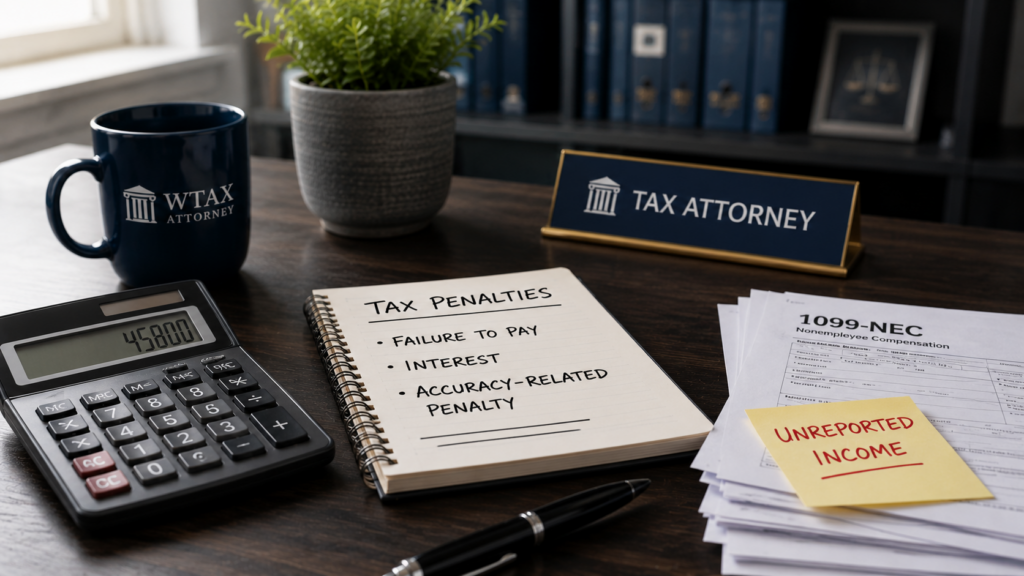
Once the IRS adjusts your tax return, it will assess penalties and interest on the amount you owe. If you forgot a 1099 on your taxes, the IRS will backdate the penalties to your return due date. Interest accumulates on an unpaid tax balance from the return’s due date until you pay the amount due in full.
Failure-to-Pay Penalty
The IRS imposes failure-to-pay penalties of 0.5% for every month you do not pay your tax balance. However, if your unreported 1099 income represents a substantial understatement of your tax liability, the IRS may increase the penalty to a 20% accuracy-related penalty. A “substantial understatement” is defined as anything greater than 10% of the correct amount or $5,000.
Penalty Abatement
The IRS may be willing to waive penalties, especially when taxpayers have never incurred penalties before or have a valid reason for not paying on time (reasonable cause).
Examples of valid reasons for failing to pay on time include a natural disaster, the death of an immediate family member, or a system issue that delayed an electronic payment.
As of 2026, the IRS applies first-time penalty abatement automatically to qualifying taxpayers. That starts with the 2025 tax returns. For older returns, you can request penalty abatement. Call the IRS or send Form 843 (Claim for Refund and Request for Abatement) and a copy of the CP notice you received about the unreported 1099.
Is It a Crime If I Forgot to Include a 1099 on My Tax Return?
Taxpayers who fail to report 1099 income but amend their return in time or respond to a CP notice are generally not in trouble with the IRS. However, if the IRS detects criminal willfulness, it will launch a criminal investigation.
IRS investigators typically suspect tax fraud when they detect:
- False Social Security numbers or falsified documents
- Intentional underreporting of income
- A deliberate failure to file taxes
Forgetting to file a 1099 and handling it through the proper channels, such as amending your return or responding to a CP notice, does not constitute fraud. The key distinction is intent.
What If You Cannot Pay Taxes on the Missing 1099?
Taxpayers who forget to report 1099 income are often ill-prepared for an adjusted tax balance. If you cannot afford to pay taxes on unreported 1099 income, you can consider one of the available tax debt resolution options.
- Installment Agreement: This option allows you to pay your balance over time. There are both long-term and short-term arrangements you can apply for.
- Offer in Compromise (OIC): This program allows you to pay less than you owe the IRS, but only if your limited assets and income prevent you from paying in full.
- Currently Not Collectible Status: If you can prove that paying the tax you owe puts you in a financial hardship, the IRS can put your tax account on CNC status. This temporarily pauses collection efforts.
Don’t Face the IRS Alone: Get Help With Unreported 1099 Income
Dealing with the IRS can be daunting and stressful if you have a 1099-related issue. Partner with one of our knowledgeable and experienced tax professionals at The W Tax Group.
To get help, contact us to schedule an initial consultation and tell us about your tax situation. Then, we will formulate a strategy to get you in good standing with the IRS and resolve your unpaid tax balance.
Frequently Asked Questions (FAQs)
Do you have to report 1099 income?
Yes. The IRS expects you to report all income, regardless of how you earn it. Even if a payer doesn’t send a 1099 for whatever reason, the obligation to report that income falls on you.
What happens if I already filed my taxes and forgot a 1099?
The IRS will adjust your return if they catch the error. Otherwise, you can file an amended return. You may face penalties and interest for not reporting the income on time.
What if I do not report the info on a 1099 self-employment?
The IRS will detect the discrepancy through its automated matching system and typically issue a CP2000 notice with a proposed adjustment. Keep in mind that self-employment income is also subject to self-employment tax on top of income tax, so the total balance due is often higher than expected.
Will the IRS catch a missing 1099?
Yes. The IRS uses computerized document matching to compare every 1099 filed by payors against what you reported on your return. Even if your mailing address has changed, your Social Security number links the form directly to your account. The IRS will catch a missing 1099 in most cases; the only variable is how quickly.

