
What Happens If You Don’t File Taxes: IRS Consequences Explained

Filing a tax return isn’t always at the top of everyone’s priority list. But by law, filing requirements exist, and if your income meets certain thresholds, you must file a return.
The type of income you earn, your age, and your filing status all determine whether that obligation applies to you.
The IRS Doesn’t Forget: What Non-Filing Means for Your Tax Bill
What happens if you never file taxes at all? The short answer depends on whether you owe money or the IRS owes you.
If the IRS owes you a refund, you simply lose it after three years. No penalties, but no refund either. If you owe taxes and don’t file, the consequences are more serious:
- Penalties start accruing from day one
- Interest compounds on the unpaid balance
- The IRS can eventually file a return on your behalf, usually without your deductions
- From there, it can move to collect, meaning tax liens, wage garnishment, or a levy on your bank account
What makes this different from most tax problems is the time factor. The IRS has no statute of limitations on a return that was never filed. It can go back as far as it needs to.
Each of these consequences is covered in detail further down, starting with what happens to your refund and moving through penalties, IRS enforcement, and your options.
Can I Lose My Tax Refund If I Don’t File My Taxes?

Yes. And once the window closes, the refund is gone permanently. You have three years from the filing deadline to claim a tax refund for any given year. Miss that window, and the IRS keeps the money.
Here’s how the three-year rule plays out depending on how many years you’ve missed:
- 1 or 2 years behind: you can still claim refunds for both years, as long as each falls within its own three-year window
- 3 years behind: you can claim refunds for all three, but only if you act before the window closes on each one. See our page on the three years of missing returns
- 5 years behind: you can only claim refunds for the three most recent years; the two oldest are permanently forfeited
There’s another layer to know. The IRS may not release your refund if you file a claim but have missing returns from prior years. For instance, if you file your 2025 tax return but haven’t filed 2024, the IRS may hold your 2025 refund until the agency confirms you don’t owe for 2024. The IRS has the right to offset refunds against unpaid taxes from prior years.
Consequences of Not Filing Taxes
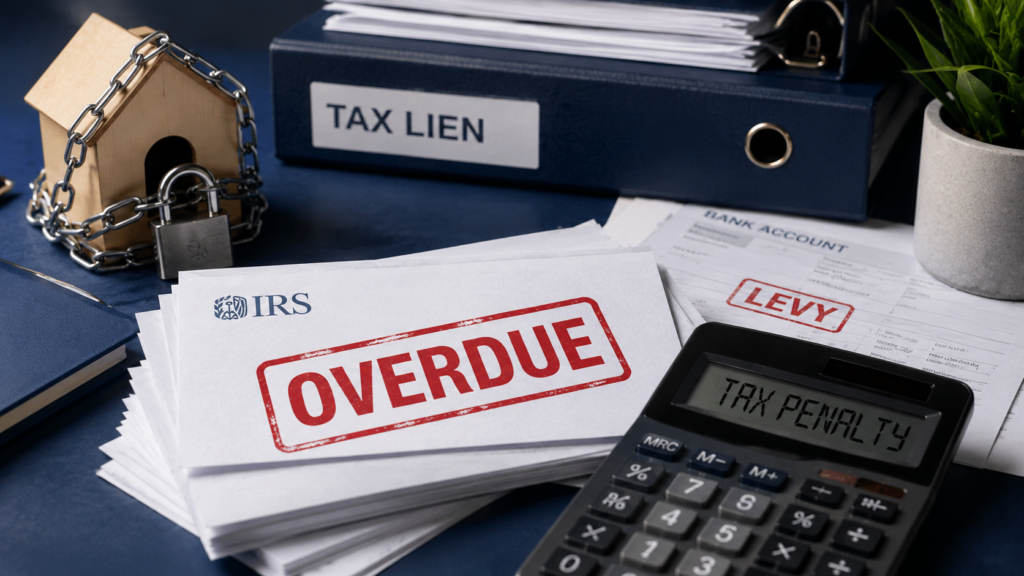
If you have a tax liability and don’t file, here’s what can happen. The full breakdown of consequences for not filing taxes covers each of these in further detail.
Tax Penalties and Interest
The IRS assesses both interest and penalties when returns are filed late. The failure-to-file penalty is 5% of the taxes you owe per month for the first five months, up to 25% of your tax bill. On a $1,000 balance:
- The failure-to-file penalty is $50 per month, up to $250
- The failure-to-pay penalty is just $5 per month (0.5% monthly)
- Filing on time but paying late carries a penalty ten times less than not filing at all
The failure-to-file penalty applies the very first day you are late, and interest starts to accrue right away, too. If possible, you should file taxes even if you can’t pay. The penalty for unpaid taxes is 0.5% each month, far lower than the 5% failure-to-file penalty.
Substitute for Return (SFR)
Since the IRS may not have complete information about a taxpayer, it may prepare a Substitute for Return (SFR) and overstate the taxes owed. This often leads to owing more taxes than if you had filed your own return.
In most cases, it’s in the taxpayer’s best interest to file their own return to take advantage of exemptions, credits, and deductions they’re entitled to. If the IRS files on your behalf, the SFR won’t include any credits or exemptions, which unnecessarily increases your tax debt.
The IRS begins the SFR process by sending a letter informing you that it has not received your tax forms for the applicable year. It then proposes a tax liability based on your income from those years, plus additional penalties and interest. From that point, you have 30 days to do one of the following:
- Submit a completed Form 1040 or any other required tax forms
- Agree to sign a Consent to Assessment and Collection
- Send a letter providing reasons you are not required to file, or any special circumstances you feel the IRS needs to consider
If you don’t respond within 30 days, the IRS sends a statutory notice of deficiency known as a 90-day letter. This notifies you that the IRS is going to assess the tax debt along with penalties and interest, and informs you of your right to petition the U.S. Tax Court within 90 days of the date of the letter. If you don’t respond to the notice of deficiency, the IRS can assess taxes and begin collection efforts.
Collection Actions for Unpaid Taxes
When you file a return, or the IRS files an SFR, that shows a balance due, the IRS will try to collect those unpaid taxes. This means the IRS may:
- File a tax lien that attaches to your property or rights to property
- Place a levy on your bank account, wages, or other sources of income
- Seize your property, and in some cases, you can even take your home if you don’t pay taxes
Tax-Related Identity Theft
If you haven’t filed taxes, it increases your risk of tax-related identity theft. With this scam, someone uses your Social Security number, files a fake return, and has the refund sent to their bank account. When you try to file for that year, you’ll incur processing delays while the IRS resolves the duplicate submission. The IRS advises people to file taxes as early as possible to minimize this risk.
Do I Need to File Back Taxes?
The IRS has very specific rules on who needs to file taxes every year. As of 2022, you must file a tax return if you meet any of the following criteria:
- Your income is over $12,550, and you’re filing as single
- Your income is over $25,100, and you’re filing as married filing jointly or as a qualifying widower
- Your income is over $5, and you’re filing as married filing separately
- Your income is over $18,800, and you’re filing as head of household
- You owe the alternative minimum tax
- You owe an early withdrawal penalty from an IRA or 401(k)
- You owe household employment taxes
- You owe Social Security or Medicare taxes on tips
- You have over $400 in net earnings from self-employment
The income filing threshold is higher for people over age 65. For instance, if you’re over 65 and filing as single, you don’t have to file unless your gross income is over $14,250. The rules also differ for people who are claimed as a dependent on someone else’s return.
Keep in mind these are 2022 figures. Income thresholds change every year, so to determine if you needed to file for a specific missed year, you need to look at the filing requirements for that year, not the current year.
Do I Have to File a Return for Every Year I Missed?
In some cases, you may not need to file for every year you missed a return.
Here’s a practical example. Say you’re a single filer who hasn’t filed taxes for five years:
| Year | Income | Filing Required? |
| 2016 | $20,000 | Yes, above threshold |
| 2017 | $2,000 | No, below threshold |
| 2018 | $30,000 | Yes, above threshold |
| 2019 | $5,000 | No, below threshold |
| 2020 | $25,000 | Yes, above threshold |
No self-employment income in any of those years, and no special tax triggers.
Your income exceeded the reporting threshold in 2016, 2018, and 2020, so you must file returns for those years. In 2017 and 2019, your income was under the threshold, so you don’t have to file for those years, though you may want to if you’re still eligible for a refund.
What Is the IRS Statute of Limitations on Late Returns?
The tax code provides a distinct statute of limitations for assessment, collection, and refunds. Each operates differently, and it’s important to understand how they interact.
No Statute of Limitations on a Return Never Filed
There is no statute of limitations on a return that was never filed. This means there is no time limit for the IRS to prepare an SFR. Even if you hadn’t filed for 20 years, the IRS could theoretically go back through that entire period and assess taxes for any year you owed.
10-Year Collection Statute
Once the IRS assesses the tax liability, the 10-year collection statute of limitations applies. The IRS has 10 years to collect on a tax debt. There are various things, such as appealing the taxes, that can pause the statute of limitations. But generally, once a tax bill is more than 10 years old, the IRS can’t enforce collection actions against you.
3-Year Statute on Refund Claims
Under Sec. 6511(a) and Regs. Sec. 301.6511(a)-1(a), a taxpayer has three years from the date of filing the return to claim a credit or refund, or two years from the date the tax was paid, whichever is later. A return filed or tax paid before the last day prescribed for filing is treated as filed or paid on that last day, per Sec. 6513(a).
Here’s an example. Say you filed a return on April 15, 2018, and owed taxes. You paid the bill on October 15, 2018. You later realized you made a mistake and plan to amend your return to claim a refund. Three years from the filing date is April 15, 2021. Two years from the payment date is October 15, 2020. You can claim the refund up to the later of those two dates, which is April 15, 2021.
If no return is filed, Regs. Sec. 301.6511(a)-1(a)(2) provides that the taxpayer must file the claim for a refund within two years from the date the tax was paid. For instance, consider a taxpayer who had income taxes withheld that would have entitled them to a refund, but they never filed. They must file a claim within two years of the date those taxes were paid, not three.
Collection Statute When a Return Is Filed After an SFR
The statute of limitations on collection is 10 years from the assessment date. When the IRS prepares an SFR and the taxpayer later files their own return:
- If the balance due decreases, the collection statute stays the same as the original SFR assessment date
- If the balance due increases, the IRS collection statute resets to the date the taxpayer’s return was filed, giving the IRS a fresh 10 years to collect
What Is Form 15103?
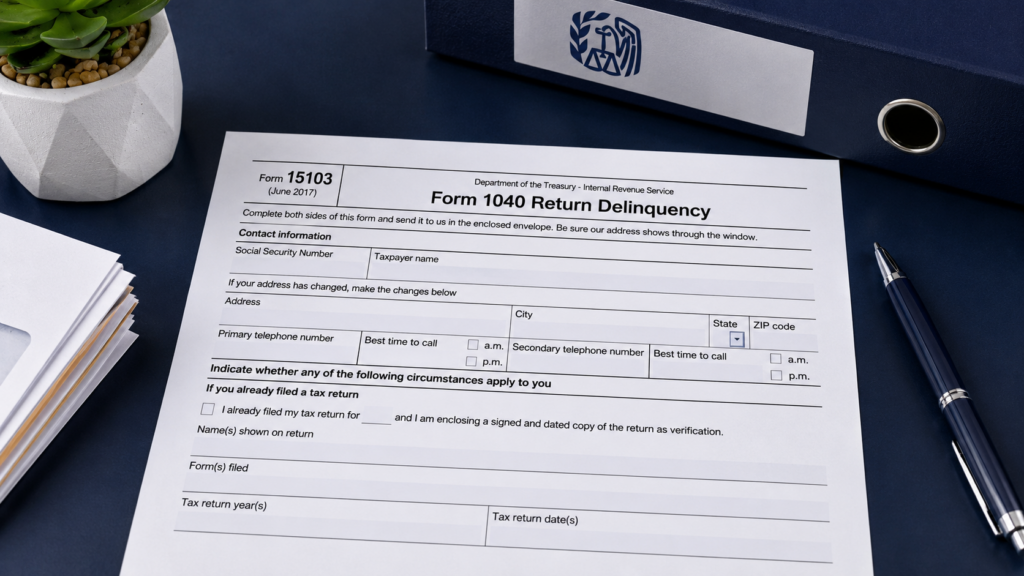
If you received a notice from the IRS regarding a late return, it may have included Form 15103, formally called Form 1040 Return Delinquency. The IRS generally sends Form 15103 with CP59, CP516, and CP518 notices to request information about your late return.
The purpose of this form is to determine your reason for not filing, such as:
- You don’t believe you’re required to file
- The person the notice is addressed to is deceased
If you received Form 15103 and haven’t filed a return, or filed longer than two months before receiving the notice, complete and return the form as soon as possible. Failure to respond can result in serious consequences, including penalties and liens for failure to file and pay.
Self-Employed, 1099, and Deceased: Filing Rules That Work Differently
Not every taxpayer faces the same IRS filing obligations. Here’s what changes based on your situation.
What If a Deceased Person Has Missing Tax Returns?
Sadly, even death doesn’t necessarily get you out of paying taxes. Depending on the situation, if a deceased person has missing returns, you may need to file them. The estate may need to pay the resulting tax liability. See our guide to tax debts for deceased taxpayers to learn more.
What If a Self-Employed Person Doesn’t File Taxes?
Self-employed people are required to file taxes annually if they earn over $400 after expenses. Failing to file opens you to the risk of the IRS finding you and subjecting you to penalties and collection actions. Not filing can also make it impossible to get loans and grow your business. See our guide on self-employed taxpayers and missing returns for more details.
What If You Don’t Report 1099 Income?
If someone issued you a 1099, but you didn’t file a return, the IRS may notice the income and reach out to you. Similarly, if you filed a return but forgot to include your 1099 details, the IRS may also contact you. You don’t want the IRS adding this income to your return and assessing tax without you being able to claim deductions or expenses. See our guide on unreported 1099 income for more details.
How to File Late Tax Returns

If you have years of missing returns, reach out to a tax professional, or work through the process yourself. Here is a breakdown of how to deal with your late returns.
Start by contacting the IRS to determine your account standing. Find out who your case is assigned to, if appropriate, and whether the IRS has already filed a Substitute for Return for you.
When you contact the IRS, you can also request your wage and income transcripts for those years. These show what income was reported under your Social Security number and help you reconstruct accurate returns even if you’ve lost your own records.
From there, work through the following:
- If an assessment has already been directed to your account, request additional time to file your own return
- File as soon as you can; the longer missing returns sit, the more likely collection actions become
- Gather all available information about investments and other income beyond your W-2 and 1099 transcripts
- Review your account transcript for any estimated payments or credits already applied to those years
- Do a thorough review for each year to identify every credit, deduction, and exemption you’re entitled to
- Use the tax form from the year in question, not the current year’s form; the tax code changes frequently, and each year’s form reflects the rules in effect that year
Contrary to popular belief, addressing late returns proactively doesn’t trigger IRS problems. For taxpayers managing multiple missed years at once, our unfiled tax help page covers the full resolution process, including how a tax professional can help you get the best outcome for your situation.
How Many Years of Back Taxes Do I Need to File?
The number of years you need to file depends on how long it’s been since your last return:
- Three years behind: file all three
- Five years behind: file all five
- Ten or more years behind: typically only six years required
This is why it’s important to work with someone who has experience with delinquent returns. Make sure you or your tax preparer understands IRS Policy 5-133, which maintains that a taxpayer generally only needs to file six years of back tax returns to be in good standing with the IRS. See our page on the IRS 6-year compliance rule for full details.
As referenced above, there is no statute of limitations on a return that was never filed, so the IRS can deviate from the six-year rule. If it believes you’ve committed tax evasion or fraud, or that you owe a substantial amount, the agency may look back further than six years.
What Are the Options If You Owe Taxes on Late Returns?
If you owe taxes as a result of your late returns but don’t have the money to pay, you have options. The IRS offers a variety of tax resolution programs for taxpayers who can’t afford to pay. Depending on your situation, you may want to apply for one of the following:
- Payment plan to make monthly payments on back taxes
- Offer in compromise to reduce the total amount of your tax liability
- Partial payment plan that reduces the balance and lets you make monthly payments
- Penalty abatement to remove penalties from your account
- Currently not collectible status, where the IRS pauses collection actions on your account until your financial situation improves
Addressing late returns voluntarily, before the IRS acts first, generally results in better outcomes and preserves more options.
Take Action Before the IRS Does
Missing a tax return doesn’t resolve itself over time. The IRS has no time limit on pursuing a return that was never filed. Penalties compound from the first day a balance-due return goes missing. The longer the situation sits unaddressed, the fewer options remain available.
Understanding your filing obligations, the relevant statutes, and the six-year compliance rule is the starting point. From there, the practical steps to file back taxes and get back into good standing with the IRS are covered in detail across the pages linked throughout this guide.
Frequently Asked Questions
Is it illegal not to file taxes?
Not always. If your income falls below the IRS filing threshold for a given year, there is no legal obligation to file. But if your income exceeded the threshold and you had a tax liability, failing to file violates federal tax law and can result in civil penalties. In cases involving willful non-filing with intent to evade taxes, criminal charges are possible, though uncommon and typically reserved for the most serious situations.
Is not filing taxes a crime?
It can be. Willfully failing to file a required return is a federal misdemeanor under 26 U.S.C. § 7203. A conviction carries up to one year in prison and significant fines. In practice, criminal prosecution is reserved for deliberate, provable evasion, not taxpayers who simply fell behind or made honest mistakes.
What happens if I don’t file my taxes?
It depends on your situation. If you’re owed a refund, you forfeit it after three years. If you owe taxes, you’ll face a failure-to-file penalty of 5% per month, capped at 25%, plus daily interest. The IRS may also prepare a Substitute for Return on your behalf without your deductions, and begin collection actions such as liens and levies.
What happens if you don’t file your taxes but don’t owe anything?
If no taxes are owed and you’re entitled to a refund, the only consequence is that the refund is permanently forfeited once the three-year window closes. No failure-to-file penalty applies because there is no balance due. That said, a missing return can still complicate future filings or create issues when applying for loans or mortgages.
What happens if you don’t file taxes for a deceased person with no estate?
If the deceased had no estate and no assets, the IRS generally has no one to pursue for the resulting tax liability. However, a surviving spouse who filed jointly may carry some responsibility, and an executor who distributes assets before resolving tax debts can become personally liable. This situation warrants consultation with a tax attorney before any financial decisions are made.
